Boxing narratives - or - the stories we tell

What are boxing narratives?
Since newspapers first started covering women's boxing, sports journalists (who, historically, have been mostly male) have been trying to work out how to talk about a woman who's good at fighting.
As part of the project we identified eleven narratives which have been used by sports journalists to talk about women boxers between 1949 and 2026. We looked at why these narratives started being used and why some of them fell out of fashion. Below, we give you a brief history of the stories told about women boxers over the past eighty years.
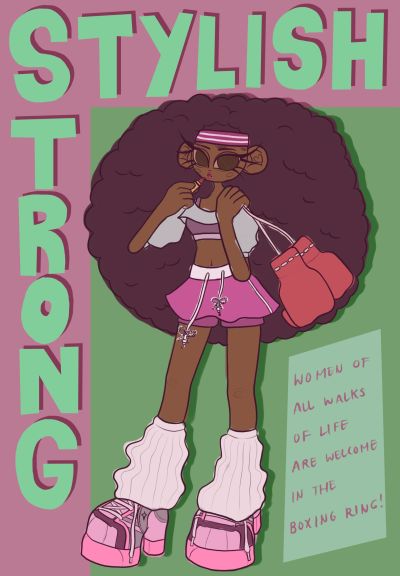
Image credit: Brianna Githuka

1940s - 1990s or What is a Woman?
When Barbara Buttrick first came to fame in the late 1940s, sports journalists didn't have any experience of writing about women boxers. One of the main narratives used was Novelty - what Barbara was doing was new and exciting. At the same time seeing a woman excel at what was seen as the most masculine sport made people anxious about whether the nature of being a woman was changing - so another narrative was Anxiety. Some newspapers and journalists refused to recognise the sport at all and wouldn't cover it in their pages, so this third narrative we call Silence. Even in the 1940s, people recognised the potential of women's of boxing to change the way society thought about women - so a fourth narrative is Women's Rights.
At the end of the twentieth century there was an upturn in women's boxing and brave women in various countries started to use equalities legislation to fight for their right to box on the same terms as men. The idea of feminism had arrived by the 1980s and 1990s, and some male commentators reacted against these new political ideas by putting down women boxers. So you start to see a narrative we call Amateurs - where journalists suggest women just aren't very good at the sport. But you also see a very angry narrative we call Abomination or Religious (Negative) where male writers suggest that women's boxing is an act against God and will destroy all that is good about what it means to be a woman - which is mainly suggested to be motherhood and caring roles.
So! By the end of the last century we see six narratives being used about women who box: Novelty, Anxiety, Silence, Women's Rights, Amateurs and Abomination.
Image credit: Polly Rowbottom

Myth and the 21st Century
After women won the right to fight professionally and in major competitions, the next battle was to see if the Olympic committee would agree to host women's boxing alongside mens. Groups of women spent a huge amount of time in the 2000s, making the case for women's boxing and the IOC finally allowed it to be included in the London 2012 Olympic Games.
Being included in the Olympic Games gives any sport a kind of prestige and authority. Now that women's boxing had reached these heights, it was harder for sports journalists and editors to ignore. But they needed to find a new way to talk about these women, because narratives like Anxiety and Abomination would sound odd attached to women winning Olympic gold medals. This is when myth arrives, in lots of different forms. Narratives like Nationalist, Fairytale and Religious (Positive) arrive to help journalists talk about fighters like Nicola Adams and Katie Taylor.
As women's boxing continues to surge through the teens and 20s, the variety and use of myth narratives continues to grow, taking in Superhero and Rebel. As social media takes over from more traditional forms of media (like newspapers), boxing promoters and the boxers themselves often create as much content as sports journalists. Myth narratives - Nationalist, Fairytale, Religious (Positive), Superhero and Rebel - remain popular with all groups.
Image credit: Elena Gould
Why Does it Matter?
The way that people are spoken about or imagined changes the way that they are treated. It matters to the careers of women boxers whether they are seen as an 'abomination' or a 'queen'. It matters to how much they earn, how much they're respected by fans or colleagues, how willing companies are to hire them to be sponsors.
There were lots of problems with the way women boxers were talked about in the twentieth century, but a lot of the narratives were what we would call socio-political. They were thinking about why women wanted to box, why women were looking for identities which were less traditionally feminine. Thinking about those things meant that women's boxing could start conversations about what it meant to be a woman, or why women might feel rage that they didn't feel able to express outside a boxing gym.
When myth narratives came on the scene, they helped to elevate the cultural status of women boxers. They were able to help women boxers seem inspiring, important and superhuman. But when we imagine that women boxers are superhuman we stop talking about what it means to be a woman, or about women's relationship with violence or rage or even mental health. People also became less interested in talking about the history of women's boxing, meaning that pioneers like Buttrick and Gogarty are more likely to get forgotten.
The narratives of the twentieth century weren't great for making women boxers famous, or for creating identities which companies could use to sell products. But they did make people think about some of the harder questions. So while women boxers and their narratives have gained a lot of power from myth in the twenty first century, they have also lost some things along the way. This project is, in part, a way of looking at some of the things which have got lost.
Image credit: Brianna Githuka